


Overview
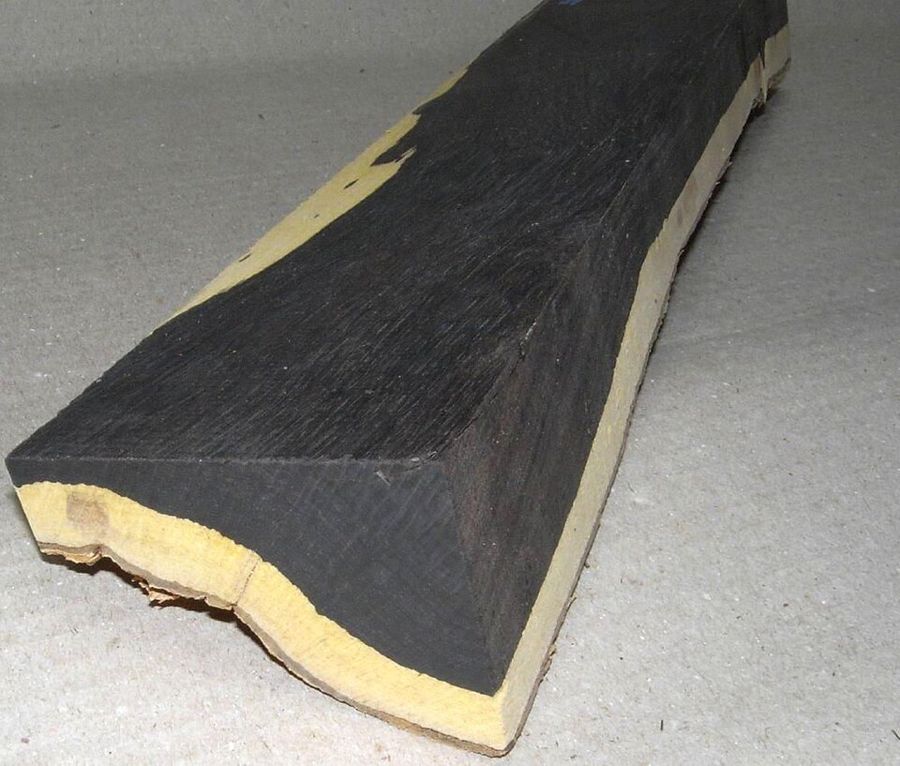
African blackwood (Dalbergia melanoxylon), mpingo or grenadilla, is usually black with little visible grain, and among the hardest and densest woods in the world. It is extremely hard to work and is the classic wood for clarinets and oboes. Boards are narrow, since the tree is small and slow growing.
Pros
- Black, fine and nearly grainless, and polishes to a high lustre.
- Janka 3,670 lbf, about 1,270 kg/m3.
- Very durable.
- Among the finest turning woods, holding threads and details well.
- More stable than other ebonies and resistant to warping (Wood Database).
Cons
- Very difficult to work, with an extreme blunting effect on cutters.
- Very expensive, similar to true ebony, with narrow boards.
- CITES Appendix II under the genus-wide Dalbergia listing; IUCN Near Threatened.
- Reported as a sensitizer.
- The pale sapwood is commonly attacked by powder-post beetles.
Variants and subspecies
- Dalbergia melanoxylon: the only commercial species.
- Mpingo, grenadilla: other names. Not related to Granadillo (macacauba).
- Not a true ebony: it is a rosewood-genus wood; for the true ebony see Gaboon ebony (African ebony).
- Substitute: Katalox (Mexican ebony) or Bolivian rosewood (pau ferro) for dark wood.
Working and finishing
Carbide or metalworking tooling and light cuts. Turns best of all uses. Polishes without a coating. Wear a respirator.
Staining and finishing colour
Black without stain. Wax or oil polishes it. Nothing needs adding.
Sustainability and handling
CITES: Dalbergia spp. (other than D. nigra) have been in Appendix II since 2 January 2017, covering all parts and derivatives except leaves, flowers, pollen, fruits, seeds and finished musical instruments, accessories and parts; non-commercial finished items under 10 kg per shipment are exempt (APHIS CITES Timber Species Manual; checked 2026-09-30). IUCN: Near Threatened (Wood Database). FSC availability is not verified here. The US Lacey Act makes it unlawful to trade wood taken or exported in breach of the source country's laws (fws.gov/law/lacey-act), so buy from dealers who can name the country and species. If a piece will be exported to or sold in the EU, Regulation (EU) 2023/1115 (the EUDR) requires due-diligence evidence that wood products are deforestation-free and legally produced; check its current application date with your buyer.
Ethical call: a poor choice outside music and small turnings; use Katalox (Mexican ebony) or Bolivian rosewood (pau ferro) for dark wood. Health: reported sensitizer with eye and skin irritation. The US National Cancer Institute reports strong, consistent associations between wood-dust exposure and cancers of the nasal cavity and sinuses, so use extraction and a respirator when sanding.
Popular projects
Clarinet and oboe bodies, turned objects, guitar fingerboards and bridges, pens and small inlays.
Buying notes
Sold as small blanks, fingerboards and guitar sets rather than boards; Exotic Lumber bowl blanks work out to about $150 to $160 per board foot (September 2026). Ask for CITES paperwork.
Typical projects
- clarinets and oboes
- turned objects
- guitar fingerboards and bridges
- inlays
- pens
Sources
- www.wood-database.com/african-blackwood
- exoticlumber.com
- www.aphis.usda.gov/sites/default/files/cites.pdf
- www.fws.gov/sites/default/files/documents/CoP19%20timber%20outcomes...
- www.fws.gov/sites/default/files/documents/2026-01/ole-public-bullet...
- www.fws.gov/law/lacey-act
- eur-lex.europa.eu/eli/reg/2023/1115/oj
Researched 2026-09-30. Prices, conservation status and CITES listings on this page are indicative and were checked on that date. They change: confirm them with your supplier, and with the relevant authority before importing or exporting.