


Overview
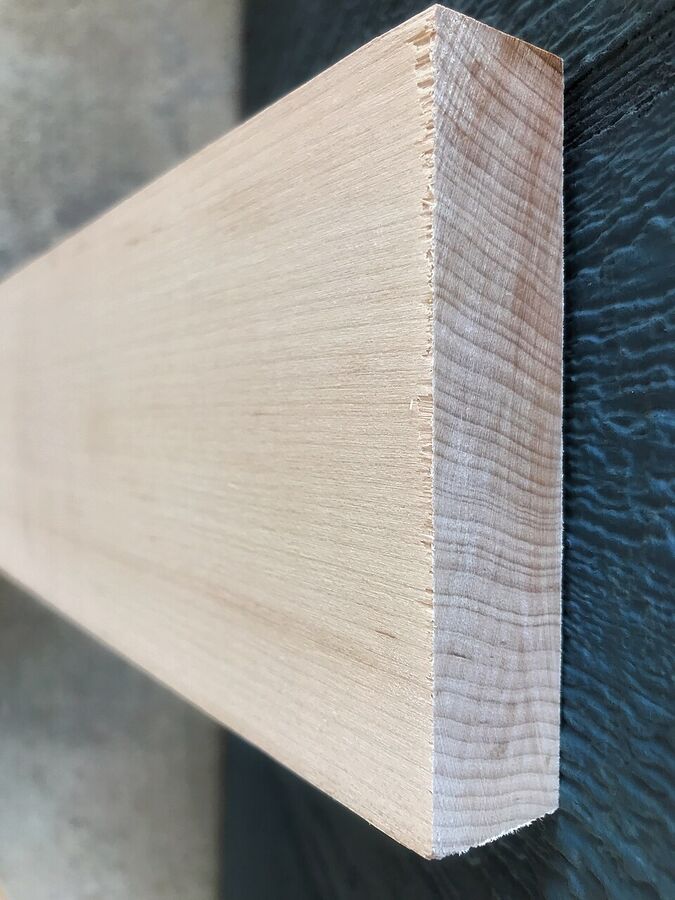
Hard maple is the pale, tight-grained, very hard maple that fills butcher blocks, bowling lanes, gym floors and bench tops. Wood Database notes that, unusually, the sapwood is the part most commonly used rather than the heartwood, so the lumber is near-white to cream and reads as clean and modern. Choose it when you want a pale, durable, wear-resistant surface and are willing to put up with a little difficulty staining and machining it.
Pros
- Very hard: Janka 1,450 lbf, harder than White oak (1,350) and Red oak (1,220), and dense at about 705 kg/m3.
- Fine, even texture; a long-standing choice for cutting boards, butcher blocks and workbenches.
- Plentiful and fairly priced for its hardness.
- Distinctive figure (birdseye, curly, quilted) is available for feature pieces.
Cons
- Rated non-durable to perishable for decay resistance and susceptible to insect attack: not for outdoor or ground-contact use.
- Shrinkage is high (4.8% radial, 9.9% tangential), so plain-sawn wide boards move.
- Burns under high-speed cutters and slow feeds, especially on the table saw and router.
- Blotches when stained (see below).
Variants and subspecies
- Hard maple vs soft maple: "hard maple" is Acer saccharum, which Wood Database calls the strongest, stiffest, hardest and densest commercial maple; the soft maples (red, silver) are lighter and softer, see Soft maple.
- Sapwood vs heartwood: sapwood (nearly white to cream) is the usual lumber; the heartwood is a darker reddish brown. CR Muterspaw lists "white" maple separately, so specify colour when ordering.
- Birdseye maple: small round "eyes" in the grain; Wood Database says it is found most commonly in hard maple, less often in other species.
- Curly and quilted maple: wavy or quilted grain patterns; Wood Database says figured pieces are likely to be much more expensive.
- Quartersawn: the image shows a quartersawn blank; it moves less than plain-sawn stock, which suits wide panels.
Working and finishing
Hard maple machines well with sharp tools but is hard on blades, and heat marks show quickly on the pale surface, so keep the feed rate up and use sharp carbide, a scraper or a hand plane to remove burns. Pre-drill for screws and nails. Sanding to a fine grit gives a very smooth surface. Wood Database describes it as turning and finishing well.
Staining and finishing colour
The tight, even grain gives uneven absorption, so pigment stains blotch badly. Wood Database advises a pre-conditioner or gel stain. Dye stains and toners are more forgiving; ebonising and painting are common.
Sustainability and handling
Wood Database reports hard maple is not CITES-listed, and the species is Least Concern on the IUCN Red List (checked 2026-09-30). It is widely harvested for lumber and for syrup. US timber falls under the Lacey Act, so buy from a dealer who knows the source. The US National Cancer Institute reports strong and consistent associations between wood-dust exposure and cancers of the nasal cavity and paranasal sinuses, so extract dust and wear a respirator. Wood Database reports that hard maple and other Acer species have caused skin irritation, runny nose and asthma-like respiratory effects.
Popular projects
Wood Database lists flooring (basketball courts, dance floors, bowling alleys, homes), musical instruments, cutting boards, butcher blocks, workbenches, baseball bats and turned objects. In furniture it suits table tops, cabinet doors and modern pieces; figured boards go to feature panels and drawer fronts.
Buying notes
Sold rough or surfaced in 4/4 to 8/4, in FAS and Select grades, and as "hard maple" or "sugar maple". Specify whether you want white (sapwood) boards, since colour variation between heartwood and sapwood is large. Figured maple is priced by the board, not by the foot; look at the actual piece.
Typical projects
- butcher blocks and cutting boards
- workbench tops
- kitchen cabinets
- flooring
- modern furniture
- musical instruments
Finishes that suit this
- Catalyzed polyurethane (2K)
- Conversion varnish
- CAB-acrylic lacquer
- Nitrocellulose lacquer
- Pre-catalyzed and post-catalyzed lacquer
- Shellac
- Water-based polyurethane
- Wipe-on polyurethane
- Water-based lacquer
- Waterborne acrylic and urethane-acrylic topcoats
- Mineral oil for cutting boards
- Polymerized linseed oil (stand oil)
- Tung oil
- Walnut oil and other food oils
- Hardwax oil
- Oil and wax blends
- Beeswax and carnauba
- Paste wax
- Wood bleaching
- Alcohol and oil-soluble dye stain
- Water-soluble dye stain
- Gel stain
- Finishing resinous and blotchy woods
- Pre-stain conditioner and washcoat
- Japanese urushi and traditional Asian lacquer
- Soap finish and lye (Scandinavian)
- Brush application
- Rubbing out a finish
- Wipe-on application
- Finishing schedules by species
- Tabletop finish schedules
Finishes to avoid
Hardware that suits this
Sources
Researched 2026-09-30. Prices, conservation status and CITES listings on this page are indicative and were checked on that date. They change: confirm them with your supplier, and with the relevant authority before importing or exporting.