


Overview
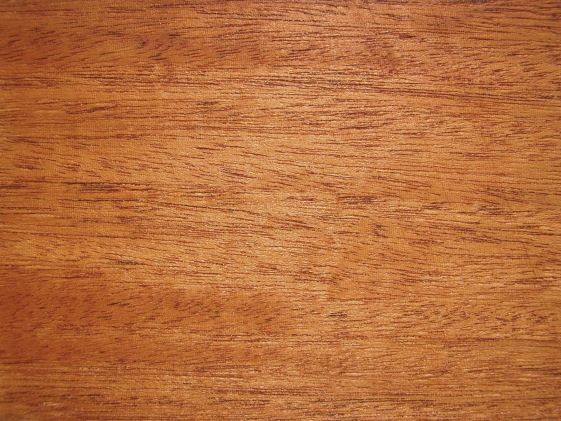
Honduran mahogany (Swietenia macrophylla), sold as genuine, big-leaf or Brazilian mahogany, is the benchmark furniture wood of the Americas. It is a warm pinkish to reddish brown, darkens with age, and shows chatoyancy (a shimmering, light-shifting figure). It is also very easy to work and very stable. Pick it for period reproductions, guitars, boats and fine cabinets, but read the sustainability section first.
Pros
- Wood Database calls it very easy to work with hand and machine tools; it turns, glues, stains and finishes well, and sands easily.
- Janka hardness is a modest 900 lbf, so it cuts cleanly without punishing tools.
- Dimensionally stable and a long-standing favourite for this reason.
- Plantation-grown lumber exists, so the species is not only a wild-forest product.
- Durability ranges from moderately to very durable, and the best old-growth stock is dense and dark.
Cons
- Wild trees are Endangered on the IUCN Red List, and legal exports are restricted by CITES.
- Costs more than African mahogany (African mahogany (khaya)), per Wood Database, and figured stock is dearer again.
- Figured or irregular grain can tear out or chip during machining, and cutters dull slightly.
- Reported as a sensitizer; eye, skin and respiratory irritation are the usual reactions.
- Colour varies a lot between boards, from pale pinkish brown to deep red-brown.
Variants and subspecies
- Honduran / big-leaf mahogany (S. macrophylla): the common commercial species, covered above.
- Cuban or West Indies mahogany (S. mahagoni): the historic prize. Wood Database gives 930 lbf and 600 kg/m3 and describes it as harvested to complete depletion; it is IUCN Endangered (over 50% decline) and effectively unavailable as new lumber. Treat any offer of it with suspicion and ask for documents.
- Pacific Coast mahogany (S. humilis): a smaller dry-forest species. Its CITES Appendix II listing covers all parts, derivatives and finished products.
- Figured cuts: quartersawn ribbon stripe, fiddleback, pommele and crotch veneer.
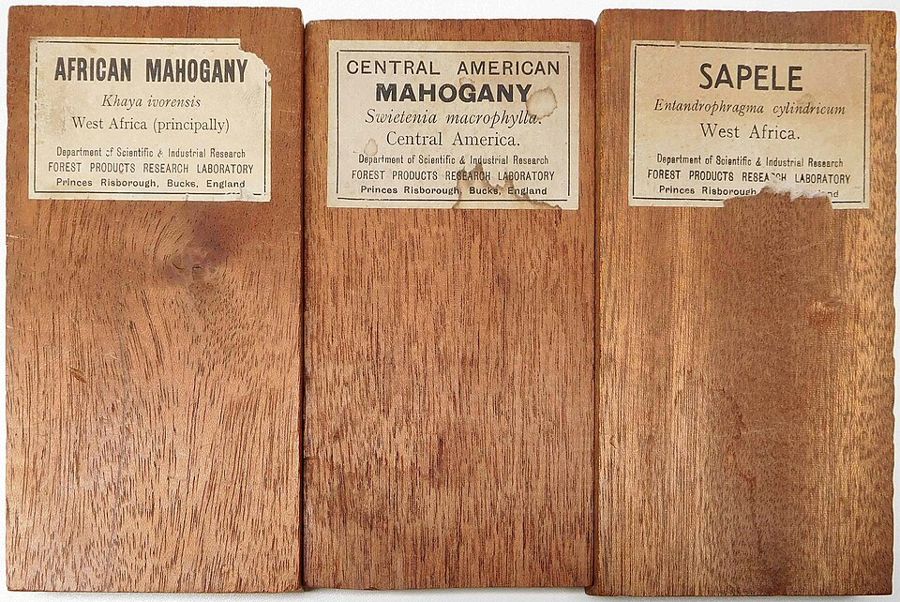
- Look-alikes: African mahogany (African mahogany (khaya)), sapele (Sapele) and the Asian Shorea timbers sold as Philippine mahogany are different woods; Wood Database notes the genus-level distinctions in its "Mahogany Mixups" article.
Working and finishing
Planes, moulds, carves and sands well; use sharp knives on figured grain or take light cuts to limit tear-out. It glues readily and holds screws and joints well. Pores are open and benefit from filling for a high-gloss film. Shellac, oil and varnish all go on without trouble, and it turns well.
Staining and finishing colour
Stains well and evenly. The colour darkens and reddens with age and light, so old mahogany is deeper than fresh stock; many makers leave it clear and let it age rather than staining it dark. Grain filler plus dye is the classic route to an even deep red. Chatoyancy shows best under a clear film over a sanded, unstained surface.
Sustainability and handling
CITES: Swietenia macrophylla is in Appendix II for the Neotropical populations (logs, lumber, veneer, plywood); S. mahagoni is in Appendix II for logs, lumber, veneer and plywood from any country; S. humilis is in Appendix II for all parts and products (APHIS CITES Timber Manual; checked 2026-09-30). The CoP20 notice of 13 Jan 2026 changes nothing for these species. IUCN: Endangered, with a population decline above 60% over three generations (180 years); Wood Database reports heavy harvest pressure in the southern range, notably Brazil and Bolivia, while northern supplies are largely exhausted and plantation timber is common. FSC availability is not verified for this guide, so ask for a chain-of-custody certificate. The US Lacey Act makes it unlawful to trade wood taken or exported in breach of the source country's laws (fws.gov/law/lacey-act), so buy from dealers who can name the country and species. If a piece will be exported to or sold in the EU, Regulation (EU) 2023/1115 (the EUDR) requires due-diligence evidence that wood products are deforestation-free and legally produced; check its current application date with your buyer.
Ethical call: a sound choice only as plantation-grown or reclaimed stock with CITES and origin paperwork. If you cannot get that, Sapele (also IUCN Vulnerable but not CITES-listed) or Spanish cedar are alternatives, and African mahogany (khaya) is CITES Appendix II and also Vulnerable. Health: reported as a sensitizer; Cuban mahogany is reported as a skin irritant. The US National Cancer Institute reports strong, consistent associations between wood-dust exposure and cancers of the nasal cavity and sinuses, so use extraction and a respirator when sanding.
Popular projects
Period reproduction furniture (Chippendale, Federal), dining tables, cabinet doors, guitar bodies and necks, boat planking and trim, turned bowls, carved mouldings, and veneered panels.
Buying notes
Sold as rough or surfaced lumber, usually 4/4 to 8/4, with FAS grades; plantation material is often narrower and paler. Two US retailers list 4/4 at $12.99 and $17.00 per board foot (September 2026). Ask for species name, country of origin and plantation or natural-forest source. Avoid anything labelled merely 'mahogany': the name is applied to several unrelated woods. Do not assume a 'Cuban mahogany' offer is legal; US retailers rarely hold any.
Typical projects
- fine furniture
- cabinetry
- boatbuilding
- guitars and musical instruments
- turned objects
- veneer
Finishes that suit this
More pictures

Sources
- www.wood-database.com/honduran-mahogany
- www.wood-database.com/cuban-mahogany
- www.bellforestproducts.com/exotic-lumber/prices
- www.aphis.usda.gov/sites/default/files/cites.pdf
- www.fws.gov/sites/default/files/documents/CoP19%20timber%20outcomes...
- www.fws.gov/sites/default/files/documents/2026-01/ole-public-bullet...
- www.fws.gov/law/lacey-act
- eur-lex.europa.eu/eli/reg/2023/1115/oj
Researched 2026-09-30. Prices, conservation status and CITES listings on this page are indicative and were checked on that date. They change: confirm them with your supplier, and with the relevant authority before importing or exporting.