

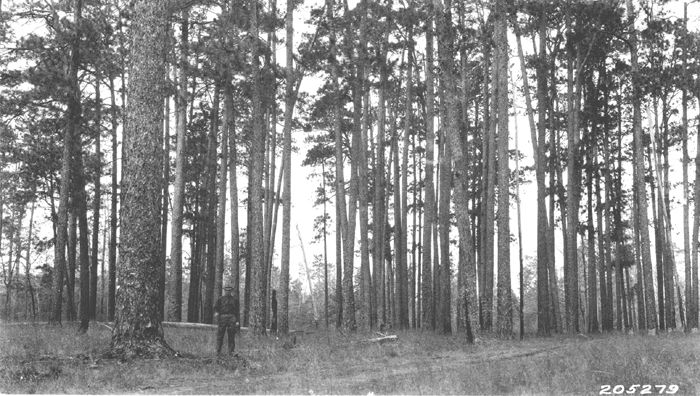

Overview
The harder, resinous pines of the American South, sold together as "southern yellow pine" (SYP): loblolly, longleaf, shortleaf and slash. This is the pine that built American houses, and it makes sturdy, characterful workbenches, stair parts, flooring and rustic furniture. Reclaimed old-growth longleaf is sold as "heart pine", the premium version.
Pros
- Hard and strong for a softwood (Janka 690 lbf loblolly/shortleaf, 760 slash, 870 longleaf).
- Strong figure: bold earlywood/latewood rings, and amber-red heart pine is beautiful under oil.
- Cheap and everywhere as construction lumber; longleaf and slash are moderately decay resistant (Wood Database).
- Glues and finishes well.
Cons
- Resin gums up blades and clogs sandpaper (longleaf, shortleaf and slash) and dulls cutting edges moderately.
- Construction-grade boards are wet, twisty and knotty; furniture-quality stock needs careful selection.
- Strong ring contrast makes stain blotchy.
- Loblolly and shortleaf heartwood have only moderate to low decay resistance.
Variants and subspecies
- Loblolly (Pinus taeda): 690 lbf, 570 kg/m3; the main plantation pine, cheapest.
- Shortleaf (P. echinata): 690 lbf, 570 kg/m3; similar to loblolly.
- Slash (P. elliottii): 760 lbf, 655 kg/m3; resinous, durable.
- Longleaf (P. palustris): 870 lbf, 650 kg/m3; the hardest and densest, and the source of heart pine.
- Heart pine: old-growth longleaf is now sold mostly reclaimed; see Reclaimed heart pine.
- Compare softer white pines in Eastern white pine and western yellow pines in Ponderosa pine.
Working and finishing
Machine with sharp carbide and clean the blades often; resin builds up quickly. Pre-drill for screws; heart pine can split. Use a coarse, open-coat paper that clogs less, wipe pitch off with mineral spirits before finishing, and be wary of surface resin bleeding through paint. Hand-planes work, but hard latewood bands chatter. Glues well.
Staining and finishing colour
Colour is orange-brown to red-brown, deepening over time. The big difference between hard latewood bands and soft earlywood causes severe blotching with penetrating stains; use a conditioner, gel stain or a toned shellac. Oil, waterborne polyurethane and shellac are all common, and heart pine takes a clear oil finish particularly well.
Sustainability and handling
Not CITES-listed (Wood Database; checked 2026-09-30). IUCN status as of 2026-09-30: loblolly, shortleaf and slash are Least Concern; longleaf pine is Endangered on the IUCN Red List per Wikipedia, whereas the Wood Database page lists it as Vulnerable, so sources disagree. Longleaf is the slow-growing, scarce member of the group, so old heart pine is best bought reclaimed. The Wood Database reports that working pine has caused allergic skin reactions and asthma-like symptoms in some people.
Popular projects
Workbenches and shop furniture, stair treads, floors, rustic farm tables, beams and posts for pergolas, and reclaimed heart pine tabletops. Choose it where hardness matters more than fine grain.
Buying notes
Sold as dimensional lumber everywhere, or as 4/4 boards from lumberyards; most "yellow pine" at big-box stores is SYP. Retail evidence: Advantage Lumber listed 4/4 rough longleaf clearance at $2.50 per bf; thewoodyard.com listed kiln-dried heart pine 4/4 at $8.00 per bf in Sept 2026. Look for kiln-dried, high-ring-count stock for furniture; reclaimed heart pine from old mills costs substantially more.
Typical projects
- flooring
- stair treads and beams
- workbenches
- outdoor structures
- rustic tables
- reclaimed heart pine furniture
Finishes that suit this
Sources
Researched 2026-09-30. Prices, conservation status and CITES listings on this page are indicative and were checked on that date. They change: confirm them with your supplier, and with the relevant authority before importing or exporting.