

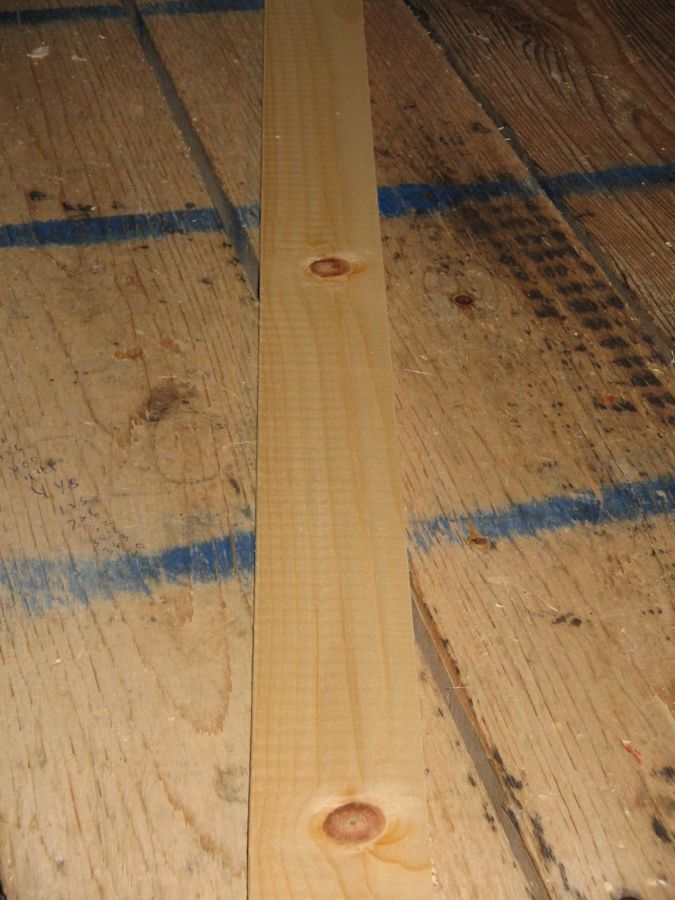

Overview
The softwood most North American woodworkers learn on: light, straight-grained, soft and cheap, with a pale cream-to-honey colour that mellows with age. It is the default for Shaker-style and colonial furniture, painted cabinets and anywhere a project needs to be built economically. Choose it when you want easy hand-tool work and are happy for the piece to take dings.
Pros
- Easy to work with hand and machine tools; planes, chisels and sands cleanly.
- Even, medium texture and straight grain; stable once dry for a softwood.
- Glues and finishes well (Wood Database).
- Cheap and available everywhere, from knotty boards to clear furniture grades.
Cons
- Very soft (Janka 380 lbf): dents from a fingernail, so it is a poor choice for a hard-use table top.
- Heartwood is only moderately to poorly decay resistant, so it is not an outdoor wood without paint and care.
- Stains blotchy; large resin canals and knots can bleed through paint (use a shellac-based primer).
- Mill-run boards are often knotty, and wide boards cup if not dried properly.
Variants and subspecies
- Clear / furniture grade: few or no knots, sold by the bf at a higher price.
- Knotty / common grades: the rustic look, see Knotty pine.
- Close cousins: Western white pine and Sugar pine are soft white pines that work much the same; Ponderosa pine and the southern pines in Southern yellow pine are harder 'yellow pine' types.
Working and finishing
Cuts and planes cleanly with sharp edges; the main risks are tear-out around knots and fuzzy surfaces from dull blades. Hand tools are a pleasure, and it is a good wood for learning dovetails. Use pilot holes near ends, since soft fibres split. Glues reliably with PVA. Sand to 180 grit; finer polishing does little on such soft fibre.
Staining and finishing colour
Pine is prone to blotchy stain, because dense latewood rejects pigment while open earlywood soaks it up. The standard remedies are a pre-stain conditioner, a gel stain, a washcoat of thin shellac, or a dye-and-toner approach, and test on offcuts first. Oil, shellac and clear finishes give the honey tone the wood is known for; it darkens to amber and orange over years. Milk paint and painted finishes hide the figure entirely and are historically correct for colonial work.
Sustainability and handling
Not CITES-listed (Wood Database; checked 2026-09-30). IUCN assessment: Least Concern as of 2026-09-30. Widely grown in managed and plantation stands. The Wood Database reports that working pine has caused allergic skin reactions and asthma-like symptoms in some people. Wear dust protection when sanding; the resin is sticky and gums blades.
Popular projects
Country and Shaker-style tables and cupboards, painted kitchen cabinets, bookcases, workbench frames, panelling and mouldings, and carving blanks. Its softness makes it a favourite for hand-tool furniture and for prototypes.
Buying notes
Sold 4/4 to 8/4, rough or S4S, from "common" (knotty) to clear. Retail price evidence: thewoodyard.com listed white pine 4/4 at $3.75 per bf in Sept 2026; countryconcepts.com listed $2.50 (4/4) and $3.25 (8/4) in 2025; Hearne Hardwoods lists a $3-10 range from unselected to C+ furniture grade. Boards sold simply as "pine" may be any of several species, so ask if species matters. Buy kiln-dried, flat stock; avoid boards with live pitch pockets.
Typical projects
- country and colonial furniture
- bookcases and shelving
- painted cabinets
- workbenches
- mouldings and panelling
- carving blocks
Finishes that suit this
- CAB-acrylic lacquer
- Dewaxed shellac
- Shellac
- Water-based polyurethane
- Water-based lacquer
- Waterborne acrylic and urethane-acrylic topcoats
- Gel stain
- Finishing resinous and blotchy woods
- Pre-stain conditioner and washcoat
- Soap finish and lye (Scandinavian)
- Finishing schedules by species
Finishes to avoid
Sources
Researched 2026-09-30. Prices, conservation status and CITES listings on this page are indicative and were checked on that date. They change: confirm them with your supplier, and with the relevant authority before importing or exporting.