

Overview
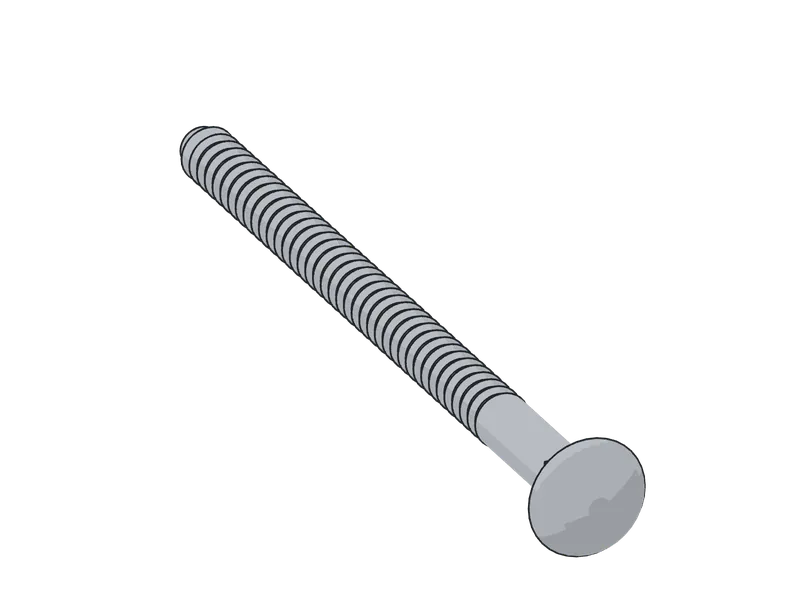
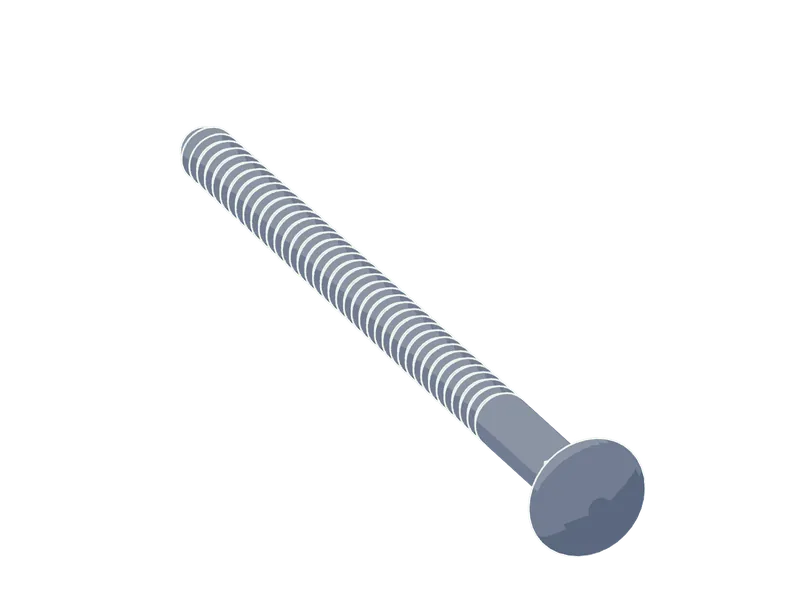
A carriage bolt has a smooth, domed head, a short square section under the head and a threaded shank. Hit the head with a hammer and the square section pulls into the wood fibres and holds the bolt still while you tighten the nut. The result is a through-bolt that needs a spanner on one side only, with a smooth rounded head on the other, which suits play structures, workbenches and heavy outdoor frames where something must be clamped hard.
Types and sizes
- Diameters: 6 mm (1/4 in) up to 16 mm (5/8 in); the library uses 9.5 mm (3/8 in) and 12.7 mm (1/2 in).
- Length: choose to pass through the parts, a washer and a nut with two threads showing.
- Finishes: hot-dip galvanized for outdoors; zinc-plated for indoors; stainless for marine and where it must not stain the wood.
- Variants: square-neck, ribbed-neck and finned-neck for timber; they differ in how they resist spinning.
Where it is used
Backyard play structures, beams, benches and gates where the load goes through the bolt. The example library's play set uses 9.5 x 150 mm and 12.7 x 180 mm carriage bolts for through-bolted structural connections. In furniture they appear on rustic work such as benches and sturdy outdoor chairs, and on workbench leg-to-rail connections.
Choosing and sizing
Shank diameter should be 1/6 to 1/4 of the thickness of the pieces being joined. Use at least two bolts at each joint, 4 bolt diameters from the end of a member and 2 diameters from the edge, to avoid splitting. Use a washer under the nut, and a larger washer (or plate) if the wood is soft.
Installation
- Clamp the parts in their final position and drill through both together with a bit the size of the shank, or 1 mm (1/32 in) larger for ease.
- Drive the bolt from the visible side with a mallet until the head seats and the square neck is fully in the wood.
- Fit a washer and nut and tighten with a spanner; the neck stops the bolt turning.
- Re-tighten after the first season, when the wood has dried and shrunk.
- Cut any excess length with a hacksaw, file the burr, and fit a cap nut where children could touch the end.
Wood movement and species
Wood shrinks across the grain but not along it. A bolt through a wide board's width sits in a slot that the wood moves across; tightening the nut hard on a board that will shrink across 3 mm (1/8 in) or so will crush the wood. Check tight after drying. Oak and other tannin-rich woods (White oak) attack plain steel in damp conditions; use hot-dip galvanized or stainless. Dense woods (Ipe, Osage orange, Teak) need a pilot hole, and a bit a little larger than the bolt. Do not mix stainless fittings with aluminium or zinc in wet conditions; see galvanic corrosion.
Common mistakes
- Hole too tight: the square neck splits the wood.
- Hole too loose: the neck cannot bite and the bolt spins.
- No washer under the nut: the nut sinks into soft wood.
- Mixing metals in a wet location.
Related
- Wood screw: lighter fixings with no nut.
- Machine screw and T-nut: when the joint needs to be removable.
- Hanger bolt: a bolt with a wood thread at one end.
- Cross dowel and bolt: a bolt that engages inside a board.
Suitable for
Fixes into: hardwood, softwood, reclaimed.
In our designs
Our example designs model this as CarriageBolt_10mmx150, CarriageBolt_12mmx180, drawn with the round shape, placed with a hardware_mount join.
Sources
Updated 2026-10-03. Sizes and ratings are typical trade figures drawn from the sources above. A load rating is the maker's rating for one product, not a property of the type: check the maker's own sheet, and test a fit on scrap before cutting good wood.