

Overview
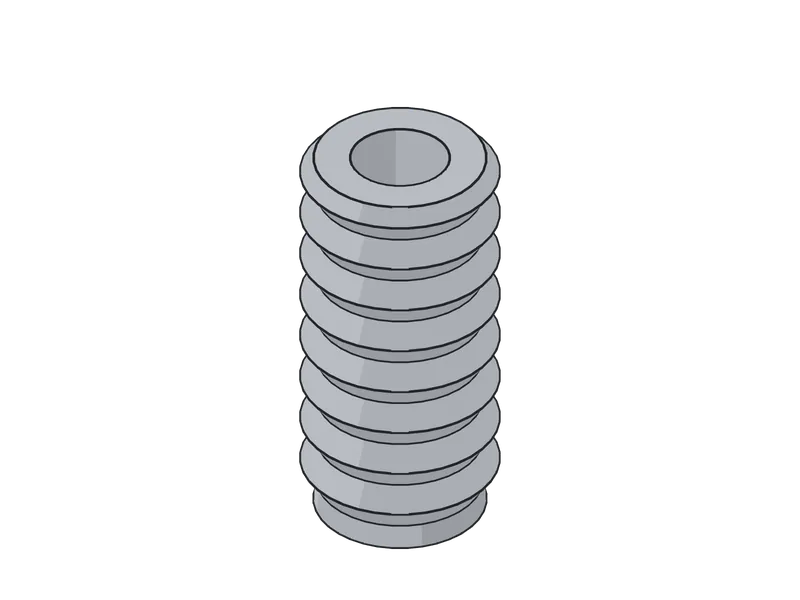
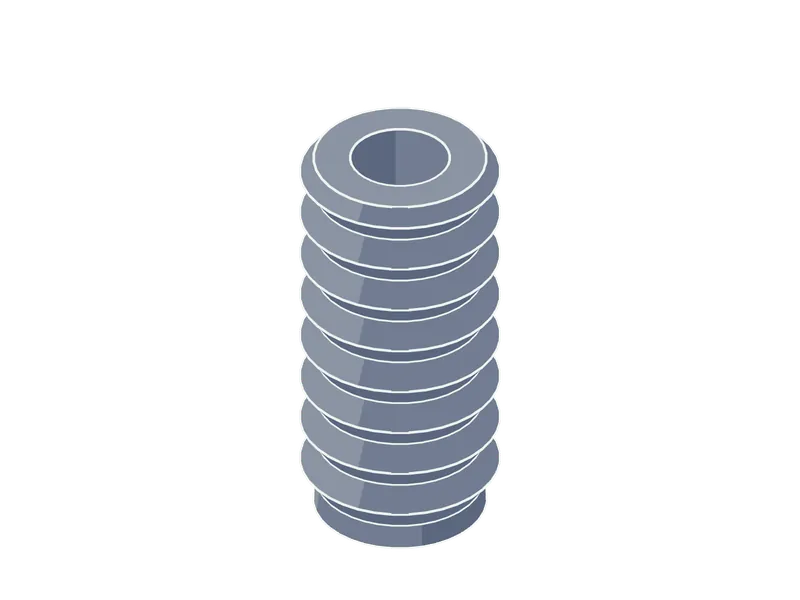
A threaded insert is a small piece of metal tube with a coarse external thread and a fine machine thread inside. You screw it into a hole drilled in a board and it forms a permanent machine-thread socket. Once in, a bolt or machine screw can be threaded in and out hundreds of times without wearing the wood. It is the standard way to get a reliable thread into the end grain or edge of a board where a wood screw would fail.
Types and sizes
- Screw-in (self-tapping): a coarse thread cuts into the wood; driven by a hex key or screwdriver slot.
- Hammer-in or press-in: for particleboard and MDF; held by barbs.
- Flanged: a collar spreads the load, and a bolt-on type goes in a counterbore.
- Two-way: an insert with internal thread and outside thread; the standard in furniture legs.
- Size: M6 (or 1/4-20, a different thread: 6.0 mm against 6.35 mm) is the common leg-bolt size; M8 for heavy knock-down frames; M4 or M5 for light hardware.
Where it is used
Removable table and chair legs where a hanger-bolt or bolt-on plate would be hard to hide; knock-down shelf and bed joints; mounting a hardware plate in particleboard; and jig and fixture work. Danish and mid-century American knock-down furniture routinely used threaded fittings so that pieces could ship flat.
Choosing and sizing
Pick the machine thread first, then the insert with that internal size. The insert's outside diameter must be less than half the thickness of the board, and it must sit at least 2 diameters from an edge. A 10 mm (3/8 in) insert wants 6 mm (1/4 in) of wood on each side. Choose a length near the thickness of the board, or two-thirds of it in end grain.
Installation
- Mark the centre and drill the pilot hole to the manufacturer's size: typically 8.5 mm (11/32 in) for an M6 insert in hardwood, 1 mm (about 1/32 in) larger for softwood.
- Drill straight; use a drill guide or a fence because a leaning insert leans the joint.
- Screw the insert in with the supplied key or with a bolt and two nuts locked together, until flush or slightly below the surface.
- In particleboard, add a drop of epoxy or thread-lock before inserting.
- Test with the bolt; it should run in by hand without strain.
Wood movement and species
An insert in end grain grips the weakest layers of fibre; give it a long length and a coarse thread, or glue it with epoxy. Inserts in softwood (Eastern white pine, Douglas fir) hold less than in hardwood (Hard maple, White oak). In MDF (medium-density fibreboard) and Particleboard, face-drilled inserts hold well but edges crumble; a flanged or glued-in type is better. Wood shrinkage can loosen an insert over a season; check it when you take the joint apart.
Common mistakes
- Pilot too large: the insert spins in the hole.
- Pilot too small: the insert splits the wood or breaks the key.
- Hole not square to the surface.
- Over-driving, so that the insert sits below the surface and the bolt cannot start.
Related
- Machine screw and T-nut: threaded joints made with a nut from the back.
- Hanger bolt: a bolt with a wood thread at one end.
- Cross dowel and bolt: a nut that sits inside the wood.
- Confirmat screw: a one-piece knock-down fixing for boards.
Styles it suits
Suitable for
Fixes into: hardwood, softwood, sheet, engineered.
Sources
Updated 2026-10-03. Sizes and ratings are typical trade figures drawn from the sources above. A load rating is the maker's rating for one product, not a property of the type: check the maker's own sheet, and test a fit on scrap before cutting good wood.