

Overview
A bail pull is a handle that swings from one or two mounts, the "bail" or "drop" form of a drawer pull. On Queen Anne and Chippendale chests it is a brass loop with a shaped backplate, the batwing or willow-shaped plate; on a Japanese tansu it is a forged iron loop on an iron backplate, where it is sometimes called a warabite (after the curling bracken-fern shape). It is the pull to choose when you want a period brass or iron silhouette and a firm grip.
Types and sizes
- Batwing and willow plates: cast or stamped brass, polished, antiqued or lacquered. The plate sits on the face and the posts pass through the drawer front.
- Cotter-pin posts: the post is threaded or split and secured inside with a nut or spread pin.
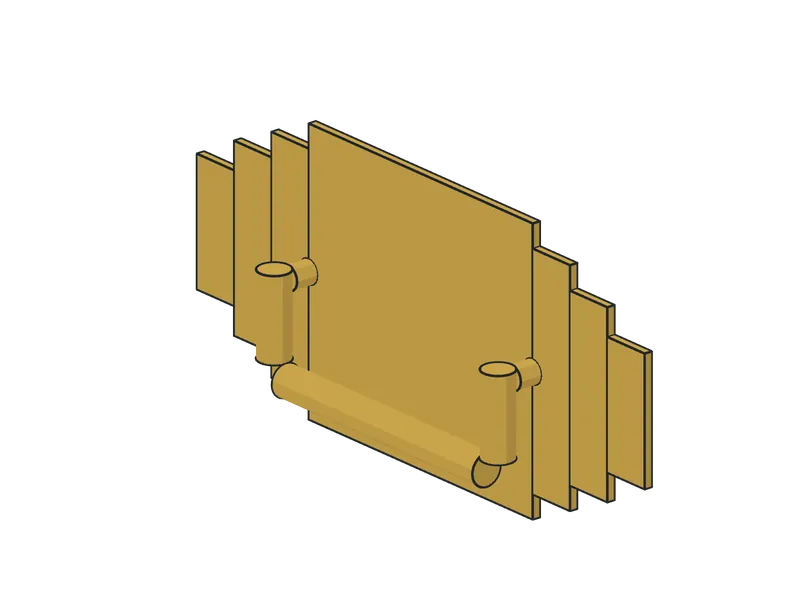
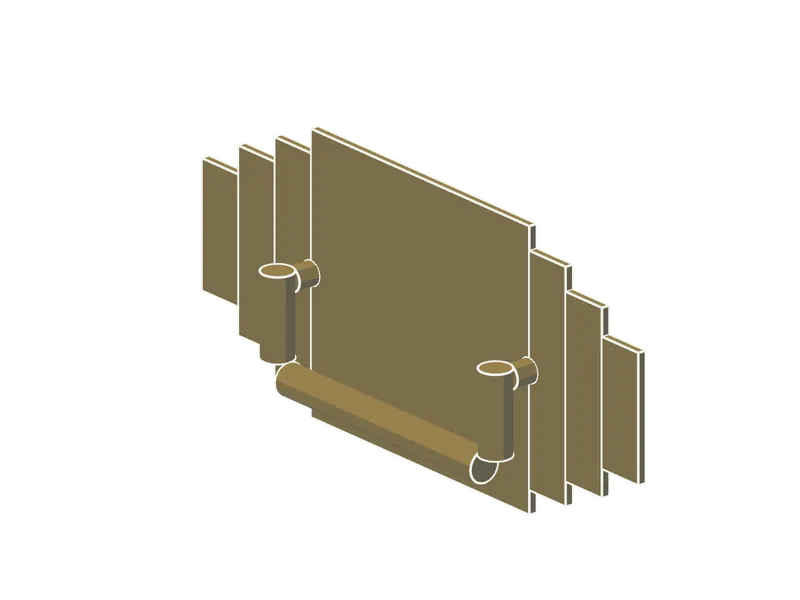
- Forged iron bail: made to order or from a small forge; the example library models one 80 mm long and 8 mm thick, standing 20 mm off the face.
- Sizes: 76 to 102 mm (3 to 4 in) between the posts; larger chests carry 100 to 130 mm (4 to 5 in) wide plates.
Where it is used
Queen Anne and Chippendale furniture use brass batwing (bail) pulls with matching escutcheons for the key. The Japanese tansu uses forged iron pulls on backplates, drawn in the style guide as a defining silhouette. On a chest of drawers the pulls are placed in line, with a matching one at each end of the drawer.
Choosing and sizing
Use the bail whose centre-to-centre matches your plate holes, and the length of post that exceeds the drawer front's thickness by about 6 mm (1/4 in) for a nut and washer. Brass bails are lighter and show handling; iron is heavier and darkens with wax. A drawer more than about 750 mm (30 in) wide can take two pulls spaced one-quarter in from each end.
Installation
- Mark the centre line and the pull centres from a paper template made from a real pull.
- Drill clearance holes for the posts, 5 mm (3/16 in) for a typical brass post, from the face with a backing board to avoid tear-out.
- Fit the posts through the plate, loop and drawer front, and fix with the nut inside. Hold the plate flat while you tighten.
- For a forged bail, bore the pilot for a short screw in the front's end grain only if the screw is long enough; a better fix is a tenon through the front with a pin.
Wood movement and species
A plate set across a wide front will fight the front's movement; keep the plate narrower than 130 mm (5 in) and the posts in a slot-free hole. Brass posts and nuts are soft: tighten gently. In oak fronts, avoid plain steel nuts and plated screws on the inside, which can stain; use brass or stainless fixings.
Common mistakes
- Posts that are too short for the front, so the nut does not seat.
- Loop that strikes the plate in use: the plate hole spacing is wrong by a millimetre or two.
- Over-polishing: brass period pulls are often left antique, and polishing removes the finish.
Related
- Escutcheon (keyhole plate): usually paired with a batwing for the key.
- Drop pull (teardrop): a smaller swinging pull for earlier work.
- Cup pull (bin pull), Knob: plainer alternatives.
Styles it suits
Suitable for
Fixes into: hardwood.
In our designs
Our example designs model this as Warabite, drawn with the bail shape, placed with a hardware_mount join.
Sources
Updated 2026-10-03. Sizes and ratings are typical trade figures drawn from the sources above. A load rating is the maker's rating for one product, not a property of the type: check the maker's own sheet, and test a fit on scrap before cutting good wood.