

Overview
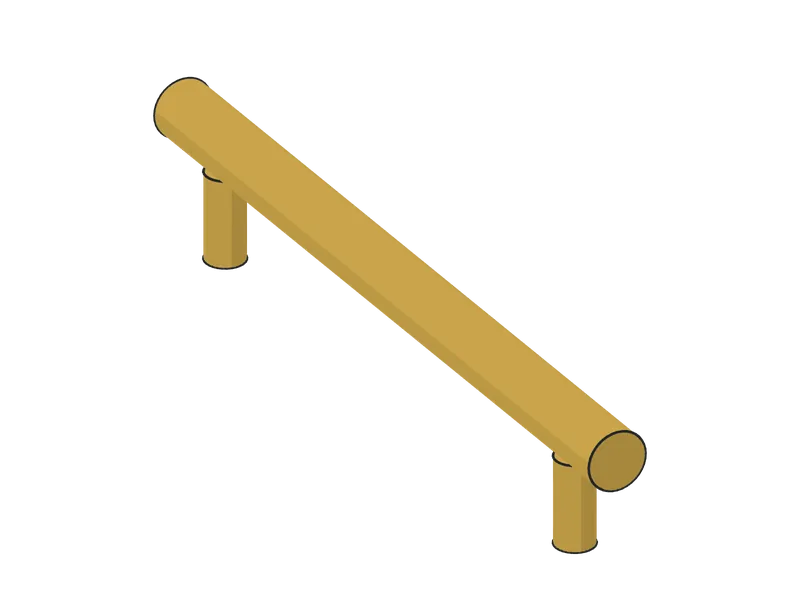
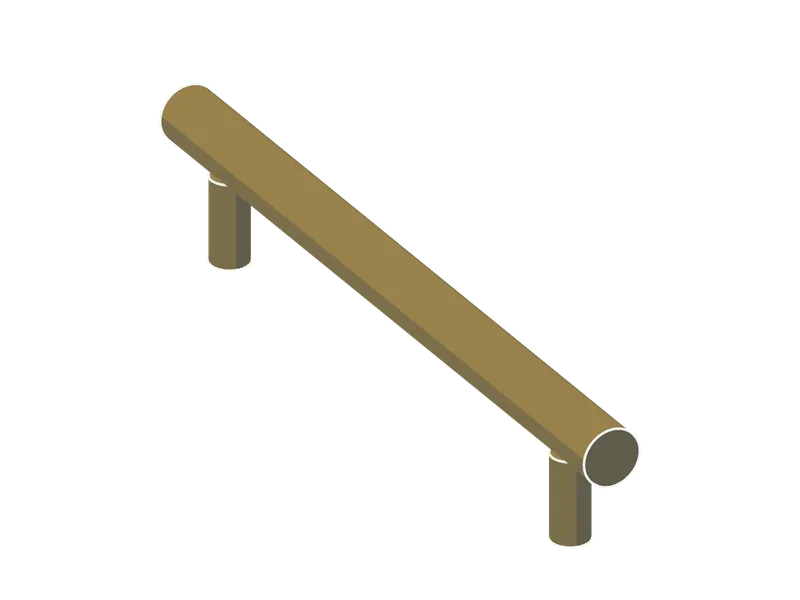
A bar pull is a handle made from a bar, straight, arched or wire-like, fixed at each end to a post that stands off the face. It is a "U-shaped" pull in the drawer-pull taxonomy. The stand-off leaves room for fingers behind the bar. It is the usual grip for a "Shaker kitchen" with plain slab drawers, and for filing cabinets and desks.
Types and sizes
- Fixed-centre bar: two posts bored through the drawer front, held by machine screws from the inside.
- Backplate bar: the posts are riveted to a plate, screwed on from the front.
- Centre-to-centre is the size: 64, 76, 96, 128, 160 and 192 mm (2-1/2, 3, 3-3/4, 5, 6-1/4 and 7-1/2 in) are the common metric and imperial equivalents, so it is worth matching. A 128 mm (5 in) centre is the default on a kitchen drawer 450 to 600 mm (18 to 24 in) wide.
- Machine screws are usually M4 (No. 8-32) and are sold in two lengths; check them against your front thickness.
Where it is used
The neo-Shaker kitchen lists wooden or bar pulls; Craftsman and English Arts and Crafts furniture used simple metal pulls and handles in iron, copper or brass, hammered or oil-rubbed. In the example library, the kitchen collection and a brass cabinet declare bar pulls with a 128 mm centre.
Choosing and sizing
Use a pull length of about one-third of the drawer front width, and make the centres match your template. For a double-door cabinet use the same pull on both doors but mount them vertically, with one-quarter of the height as the offset from the stile edge. A bar that is too long or thin bends; at 8 mm (5/16 in) diameter, keep the span under about 192 mm (7-1/2 in).
Installation
- Make a template from scrap with two holes at the pull centres, drilled with a drill press so they are square.
- Clamp the template to the front, mark the hole centres with a transfer punch, and drill a 4.5 mm (3/16 in) clearance hole for an M4 screw.
- Slide the bar over the holes and tighten the screws by hand. If the front is thicker than the screw, add a spacer or a longer screw.
- Mount pulls vertically on doors, horizontally on drawers; keep the bar parallel to the front's long edge.
Wood movement and species
A solid-wood drawer front moves across its width; the holes are 64 to 192 mm (2-1/2 to 7-1/2 in) apart, so a long pull on a wide solid front can pry the front apart. For fronts over about 300 mm (12 in) wide of solid wood, leave the screw hole on one side slightly slotted, or fix the pull to a plywood front. In MDF or particleboard the machine screw threads strip: use a Threaded insert or a washer.
Common mistakes
- Using a dimension that does not match the pre-drilled holes of an earlier pull: keep to the same centres.
- Over-tightening the screws and crushing the front surface.
- Mounting a vertical pull on a drawer.
Related
- Cup pull (bin pull), Knob: alternative grips.
- Machine screw and T-nut: the fixing for pulls and other bolted-on parts.
- Threaded insert: a more durable thread in sheet goods.
Styles it suits
Suitable for
Fixes into: hardwood, sheet, engineered.
In our designs
Our example designs model this as Pull_Bar, Pull_Brass, BarPull, drawn with the bar shape, placed with a hardware_mount join.
Sources
Updated 2026-10-03. Sizes and ratings are typical trade figures drawn from the sources above. A load rating is the maker's rating for one product, not a property of the type: check the maker's own sheet, and test a fit on scrap before cutting good wood.