

Overview
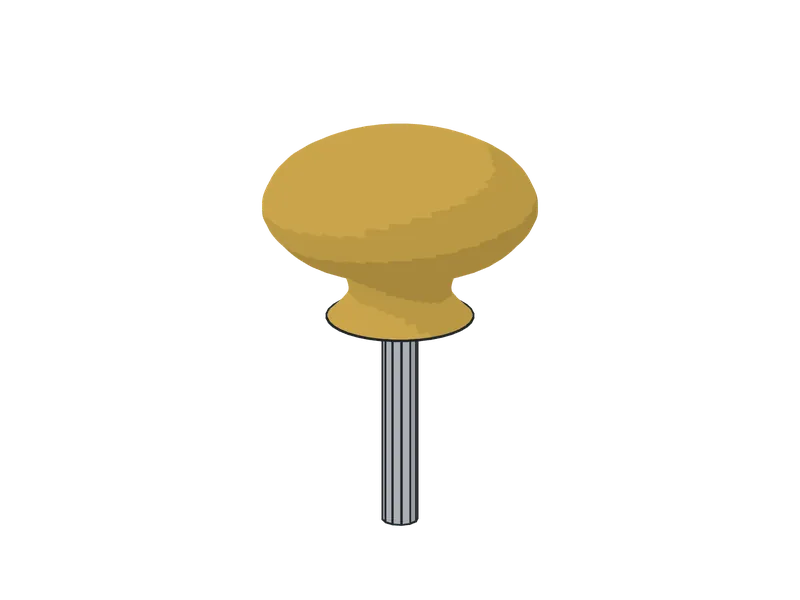
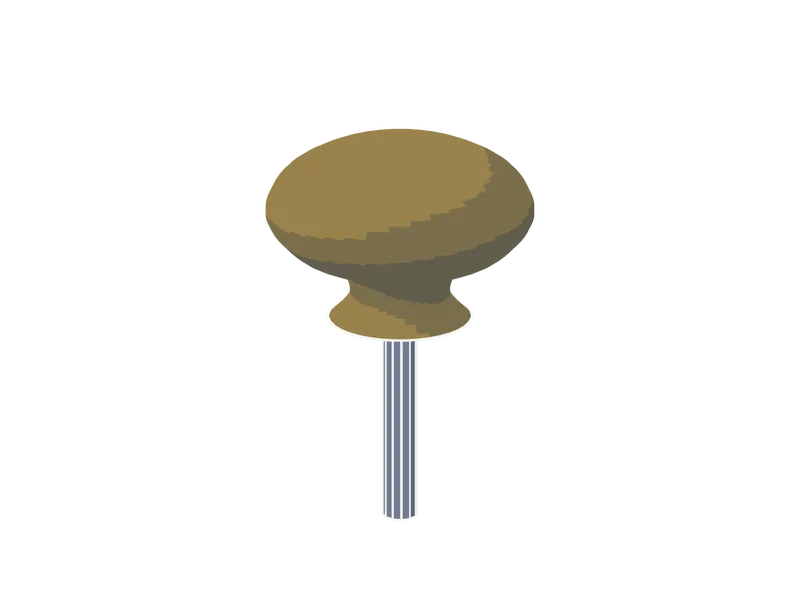
A knob is a drawer pull "in the form of a knob" in the reference taxonomy: a head you grip, on a single stem. It is the cheapest and most compact pull, and the one that suits plain furniture best. Wooden knobs can be turned by the maker, to match the piece, and fixed with a tenon glued through the drawer front.
Types and sizes
- Bought knob with a machine screw: the knob has a threaded insert; a screw from inside the drawer front pulls it tight.
- Tenoned wooden knob: a turned head with a round tenon (often 10 to 12 mm, 3/8 to 1/2 in) glued into a bored hole, optionally wedged from behind. The Shaker mushroom knob is the archetype.
- Sizes: 25 to 45 mm (1 to 1-3/4 in) diameter; 32 mm (1-1/4 in) for doors and small drawers, 38 to 45 mm (1-1/2 to 1-3/4 in) for large drawers.
- Materials: wood (matching the piece), brass or bronze for period work, plain steel for utility work; porcelain and glass knobs exist but are outside this guide.
Where it is used
Shaker furniture uses turned wooden knobs rather than brass pulls; neo-Shaker kitchens do the same for doors and drawer fronts, and country furniture uses plain wooden knobs. They are the default pull for small boxes, wardrobe doors and children's furniture because there is nothing to catch on.
Choosing and sizing
One knob in the centre of a drawer up to about 450 mm (18 in) wide; two knobs, one-fifth to one-quarter of the width from each end, above that. A door takes a knob at the stile, about 50 to 75 mm (2 to 3 in) from the top or bottom edge, depending on whether the door is a base or wall unit. A 32 mm (1-1/4 in) knob projecting 25 mm (1 in) leaves finger room for most hands.
Installation
- Mark the centre on the drawer front using a square from two edges.
- Drill the clearance hole with a brad-point bit so the entry is clean: 5 mm (3/16 in) for an M4 screw or 10 to 12 mm (3/8 to 1/2 in) for a tenoned knob.
- For a bought knob, thread the screw from the back and tighten by hand. For a turned knob, dry-fit, glue the tenon, tap home and clamp lightly.
- Hold the knob square to the face; a knob that leans reads as a mistake from across the room.
Wood movement and species
A tenon glued through a solid drawer front is cross-grain to the knob's own grain, so use a tenon with the grain running through the stem and keep the hole snug, not tight: in dry winter air a tight tenon can split the front. In particleboard and MDF a machine screw into the front alone strips; use a Threaded insert or a washer plate. A bought knob's screw is steel; in damp oak, a stain may show around it (see Wood screw).
Common mistakes
- Knob wobbles: the screw is too short or the hole too large; add a washer or a drop of thread-lock.
- The grain in a turned knob runs across the stem, so it snaps; turn it with the grain along the stem.
- Mixing sizes on one piece.
Related
- Cup pull (bin pull), Bar pull: for heavier drawers.
- Machine screw and T-nut: the screw and nut that hold a bought knob.
- Threaded insert: a more durable thread in sheet goods.
Styles it suits
Suitable for
Fixes into: hardwood, softwood, sheet.
In our designs
Our example designs model this as Knob, Knob_1_25, TurnedKnob, drawn with the turned shape, placed with a hardware_mount join.
Sources
Updated 2026-10-03. Sizes and ratings are typical trade figures drawn from the sources above. A load rating is the maker's rating for one product, not a property of the type: check the maker's own sheet, and test a fit on scrap before cutting good wood.